
Dynamic Line Rating Studies
Unlocking Hidden Transmission Capacity Through Advanced Weather-Based Analytics
Modern power systems face growing pressure from rising demand, integration of renewable energy, and the need for reliable cross-border transfer. Yet in most transmission networks, a significant amount of usable capacity remains untapped. Traditional Static Line Rating (SLR) methods rely on conservative assumptions—zero wind, high temperatures, maximum solar heating—conditions that rarely occur in real life.
Dynamic Line Rating (DLR) replaces these fixed assumptions with real meteorological data, allowing transmission operators to safely utilize additional capacity already available in the grid.
Corporate Consulting Group (CCG) provides full-cycle DLR analytics, from data sourcing to technical and economic evaluation, enabling transmission operators to make informed decisions about network utilization, congestion mitigation, and investment planning.
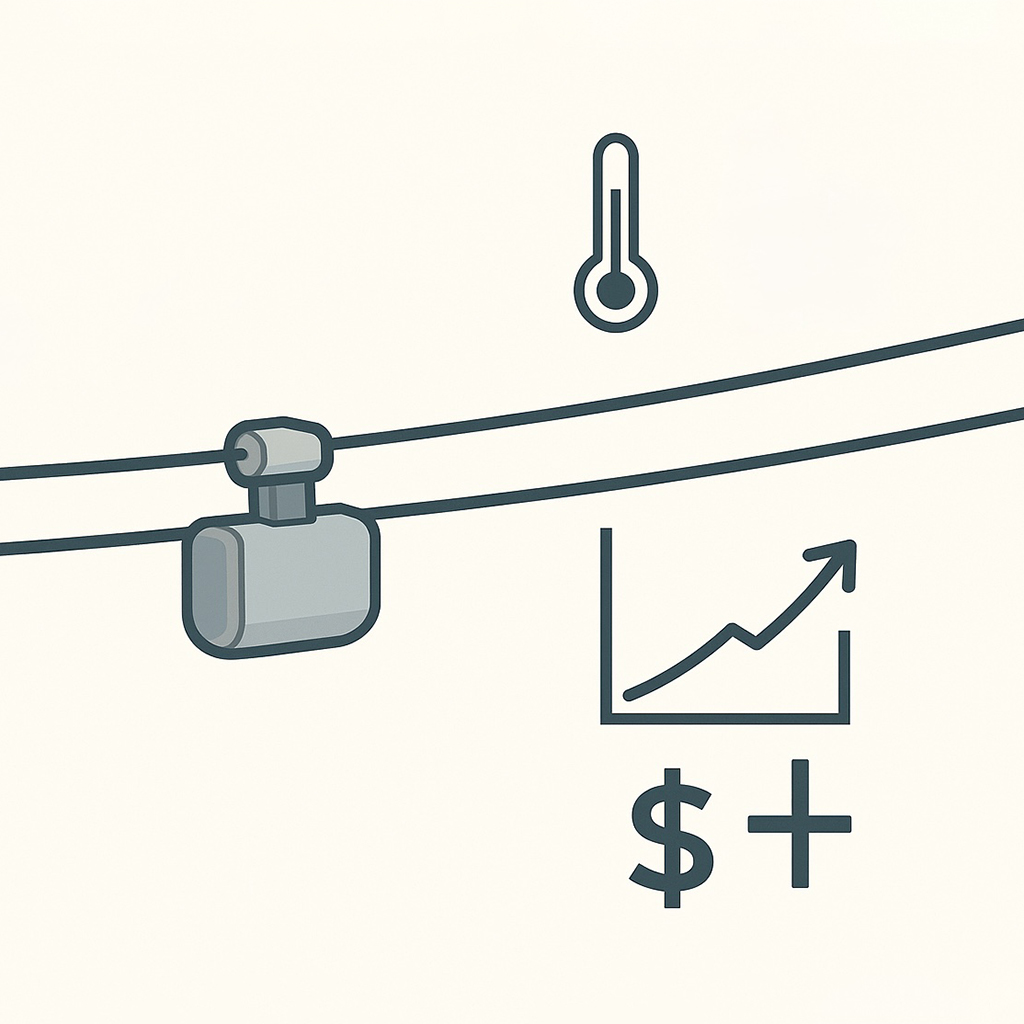
What Is DLR and Why It Matters
DLR continuously calculates the allowable ampacity of an overhead transmission line based on actual weather conditions—primarily wind speed, ambient temperature, and solar radiation. Because real-world conditions are often more favorable than the conservative SLR assumptions, lines can typically carry 15–30% more power, and in colder, windier climates even more.
DLR is not a replacement for new infrastructure. It is a low-cost, fast-to-deploy tool that allows utilities to:
- Increase transfer capacity on existing lines
- Reduce congestion and curtailments
- Improve import/export flexibility
- Defer capital investments in reconductoring or new construction
- Strengthen operational security during peak demand
Our DLR Study Approach
Dynamic Line Rating (DLR) is an advanced method for determining the real-time power transfer capability of overhead transmission lines using actual meteorological conditions rather than conservative static assumptions. Because real ambient temperature, wind speed, and solar radiation rarely match the worst-case values used in Static Line Rating (SLR), transmission lines can typically operate at significantly higher capacities for most hours of the year. This makes DLR an effective, low-cost approach for increasing transfer capability, relieving congestion, improving import and export flexibility, and postponing major capital investments. It also enhances operational security during peak seasons by unlocking capacity that already exists within the network.
CCG conducts DLR studies using a comprehensive engineering and analytical methodology grounded in the IEEE 738 and CIGRÉ TB 601 standards. Each study begins with the consolidation of historical SCADA load data, multi-year meteorological records, and detailed line design parameters. These datasets are synchronized and processed to create accurate time-series inputs for thermal and electrical modeling of the conductor. Using a span-level heat balance model, we simulate conductor temperature under real weather conditions and determine the corresponding dynamic ampacity profile, which shows how much additional current the line could have safely carried. Special attention is given to wind speed and direction, as most cooling occurs at low wind speeds and saturates beyond approximately 2 m/s; therefore, a probabilistic assessment of wind conditions along the line route plays a central role in identifying realistic DLR potential.
The results of the study provide a quantified comparison between static and dynamic ratings, expressed both as a percentage increase and as additional megawatts of transfer capability. These findings are complemented by an evaluation of the economic benefits that DLR can deliver, including the value of additional energy transfer, reduced congestion or curtailment, and the postponement of major grid reinforcement projects. The final report includes a prioritized view of which lines offer the highest technical and economic benefit, supported by clear recommendations for implementation and a roadmap covering technical solutions, pilot deployment, integration into system operations, and data requirements. Through this approach, CCG offers transmission operators a precise, evidence-based foundation for introducing DLR into their grid planning and operational practice.
Deliverables
A completed DLR study results in a comprehensive report that includes:
- Ranked list of lines with highest DLR potential
- Technical modeling results and ampacity datasets
- Economic benefit analysis
- Recommended DLR technology and vendor options
- Step-by-step deployment roadmap
Why CCG
CCG combines engineering expertise, analytical capability, and international experience with DLR programs. Our approach is tailored for utilities operating in difficult climatic environments and long-distance transmission networks.
Our studies are designed for transmission operators who seek:
- A rigorous, evidence-based evaluation
- Reliable quantification of benefits before investment
- Practical recommendations suitable for real operational conditions
связаться с нами
Мы приглашаем Вас к конструктивному и плодотворному сотрудничеству.
Доверьте нам реализацию Ваших проектов и убедитесь в эффективности наших решений.